
Guitar Physics • Intonation & Compensation
The Rebellion of the String: Why Wood and Wire Defy Pure Mathematics
The mathematical formulas that define a guitar fretboard assume a perfect world. A real guitar lives in a world of steel, nylon, wood, humidity, action height, hand pressure, and physical resistance.
The mathematical formulas that define a guitar fretboard treat a guitar string as an idealized, weightless, infinitely flexible line vibrating between two perfectly rigid points.
But when a player strings up a real instrument, they are wrapping steel, nickel, or nylon over an organic wooden structure that is constantly flexing, breathing, and resisting the physical forces of tension. This physical reality means that even if a luthier cuts every fret slot with laser-guided geometric precision, the guitar will still play out of tune.
Section 1
Mersenne’s Law and the Physical Realities of Steel and Nylon
To understand why real guitars defy pure mathematics, one must first look at the fundamental physics of a vibrating string. In an idealized physical model, the pitch of a string is governed by Mersenne’s Law, which states that the fundamental frequency is determined by its active speaking length, its internal tension, and its linear mass density.
Mersenne’s Law
f = 1 / 2L · √(T / μ)According to this formula, if a player reduces the speaking length of a string by exactly half, the frequency doubles, raising the pitch by a perfect octave. However, when a real player interacts with a real guitar, two major physical phenomena immediately break this elegant equation.
Physical Phenomenon 1: String Stretch
Before a string can vibrate against a metal fret, the player must physically press it downward through the open air gap known as the action height. This downward deflection physically stretches the string, elongating it and causing a sharp spike in its internal tension.
Physical Phenomenon 2: Bending Stiffness
Real guitar strings are made of solid, stiff materials like steel, copper wrap, or heavy nylon. Near its physical termination points—at the nut, the frets, and the saddle—a string does not bend cleanly.
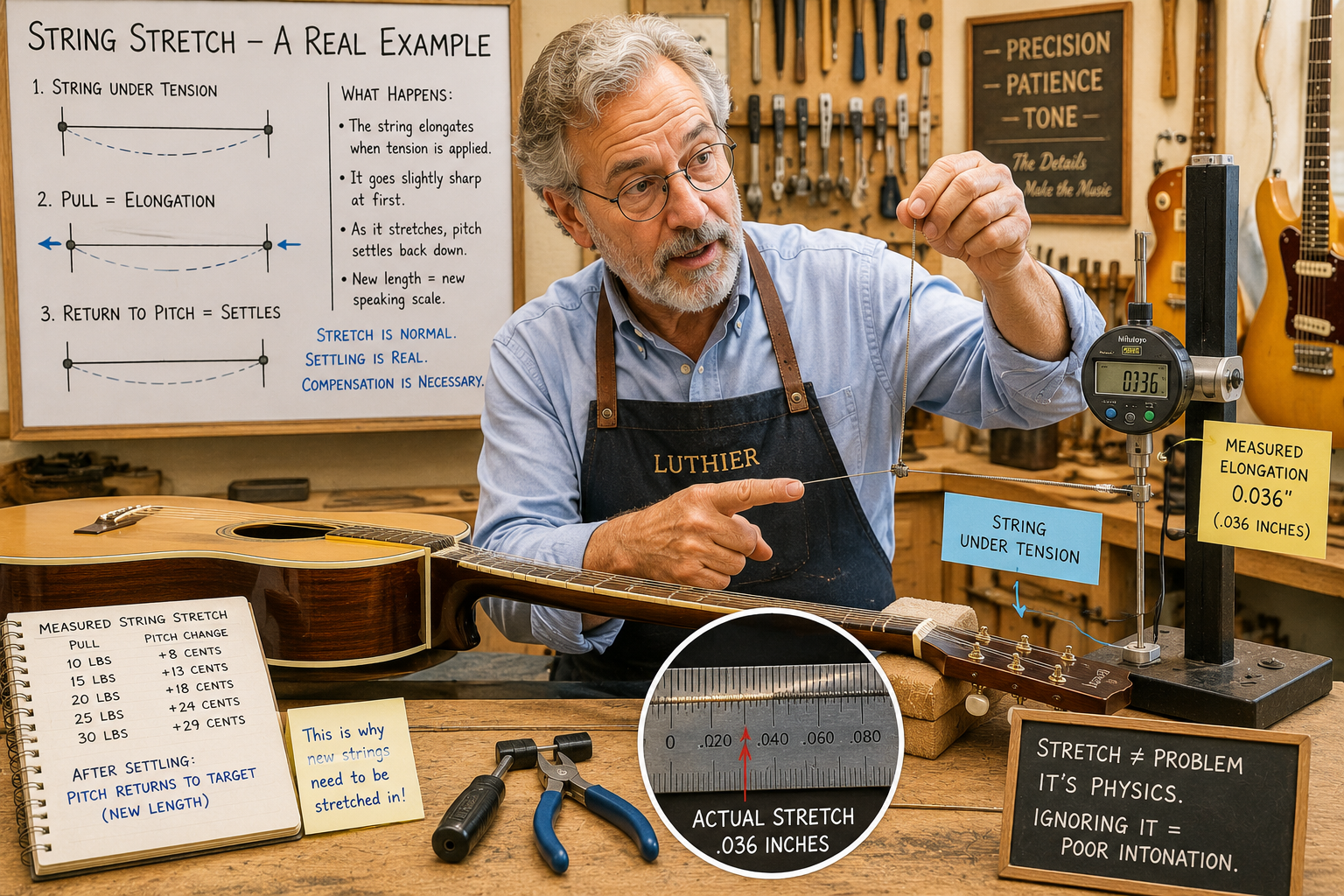

Because the string’s tension has increased, the fretted note naturally sounds sharper than the idealized mathematical formula predicts. This sharpening effect is most severe at the first few frets near the headstock, where the steep angle from the nut slot forces the string to stretch aggressively over a short distance.
Instead, a string’s intrinsic physical stiffness causes it to resist bending, acting more like a rigid metal rod near its boundaries. This stiffness prevents the string from vibrating freely at its absolute physical endpoints, effectively shortening its active speaking length and driving both the fundamental frequency and its overtones sharp.
Because these mechanical forces are constantly acting on the string, a guitar neck with purely theoretical fret placements will play progressively sharper as the musician moves up the neck.
Section 2
The Mechanics of Compensation: Setbacks and Shelves
To counteract this natural sharpening, instrument makers must physically alter the scale length of each string through a process called compensation. Compensation involves shifting the physical contact points of the string at both ends of its speaking length.
- Saddle Setback: The bridge saddle is shifted backward, away from the neck. This physical addition to the scale length flattens the pitch of the fretted notes, counterbalancing the sharpening caused by string stretch and bending stiffness.
- Nut Setback: The front edge of the nut is shifted slightly forward toward the first fret. This physical shortening of the first segment of the string prevents first-position notes from sounding sharp under the high physical tension of a first-fret press.
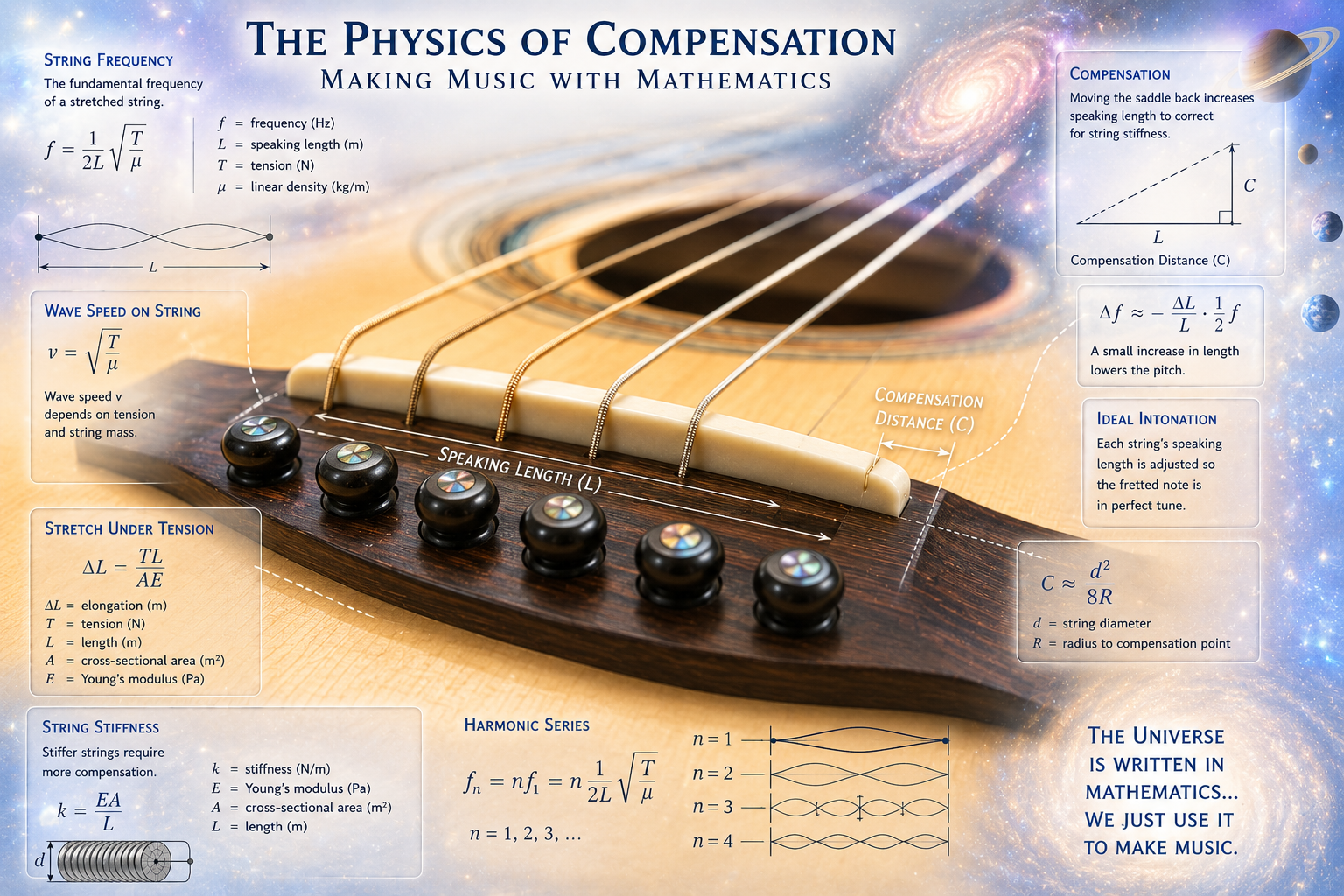
Compensated Scale Geometry
|<-- [-] [+] -->|
[Nut]=========[Fret 1]=========[Fret 12]======================
|<--------------------- Nominal Scale length (X0) -------------------->|
In 2024, physicists M. B. Anderson and R. G. Beausoleil published a landmark study in the Journal of the Acoustical Society of America that brought unprecedented mathematical modeling to this practical problem.
By analyzing a classical guitar with a standard 650 mm scale length, a nut height of 1.0 mm, and a saddle height of 4.0 mm, they utilized a least-squares fit optimization to determine the exact optimal physical compensation values for different string tensions.
| String Type & Physical Tension | Optimal Saddle Setback | Optimal Nut Setback | Resulting Residual Pitch Error |
|---|---|---|---|
| Normal Tension Nylon | +1.48 to +2.46 mm | −0.34 to −0.43 mm | 0.14 to 0.36 cents |
| Light Tension Nylon | +1.76 to +3.39 mm | −0.39 to −0.82 mm | 0.14 to 0.36 cents |
Section 3
The Acoustic Dilemma: Mass versus Pitch Precision
This scientific data reveals a profound truth: because every string has a unique material composition, thickness, and tension, every string requires its own completely unique physical setbacks. The thick, stiff low-E string requires significantly more saddle setback than the thin, flexible high-E string.
On a solid-body electric guitar, accommodating these string-specific physical requirements is relatively simple. Electric guitars can easily support heavy, adjustable metal bridges where each string rests on its own independent saddle. If a player changes string gauges, they can easily turn a screw to move the saddle forward or backward until the intonation is perfect.
However, for acoustic flat-top and classical guitars, this mechanical solution is blocked by a hard physical barrier: the acoustic transfer of energy. An acoustic guitar projects sound by transferring the physical vibration of the strings through the saddle and bridge into the wooden soundboard, causing the top of the guitar to pump up and down like a speaker cone.
To do this efficiently, the entire bridge assembly must be incredibly lightweight. If a builder adds heavy metal adjustment screws, tracks, and individual mechanical saddles to an acoustic bridge, the added mass will act as a physical dampener. This extra weight subdues the soundboard’s vibration, severely robbing the instrument of its volume, projection, and acoustic warmth.
This physical reality forces acoustic guitar builders to rely on a single, static physical compromise. Luthiers must carve a single bone saddle with a slight diagonal slope, providing a basic, fixed approximation of the necessary setbacks. This design choice preserves the natural, lightweight voice of the acoustic instrument, but it binds the guitar’s intonation to a single, chosen string gauge and physical action height.
Section 4
The Evolution of the Classical Bridge: From Torres to Roudhloff
This struggle to balance physical compensation with acoustic purity drove some of history’s most important design innovations. In Seville, Spain, during the mid-nineteenth century, Antonio de Torres standardized the modern classical guitar. Torres expanded the physical size of the guitar body, creating a soundboard that was 20% larger than those of his predecessors. To keep this larger soundboard lightweight yet physically strong enough to resist string tension, he developed a system of thin, domed wooden struts that radiated across the underside of the top.
Crucially, from about 1857, Torres began using a separate bone saddle that sat loosely in a routed wooden slot on the bridge. Prior to this, classical bridges were often simple wooden tie-blocks where the string made contact directly with the structural wood.
Torres’ separate, drop-in saddle allowed luthiers to physically adjust string heights and file specific angles into the bone, creating a non-destructive way to tune the physical scale length of each string.
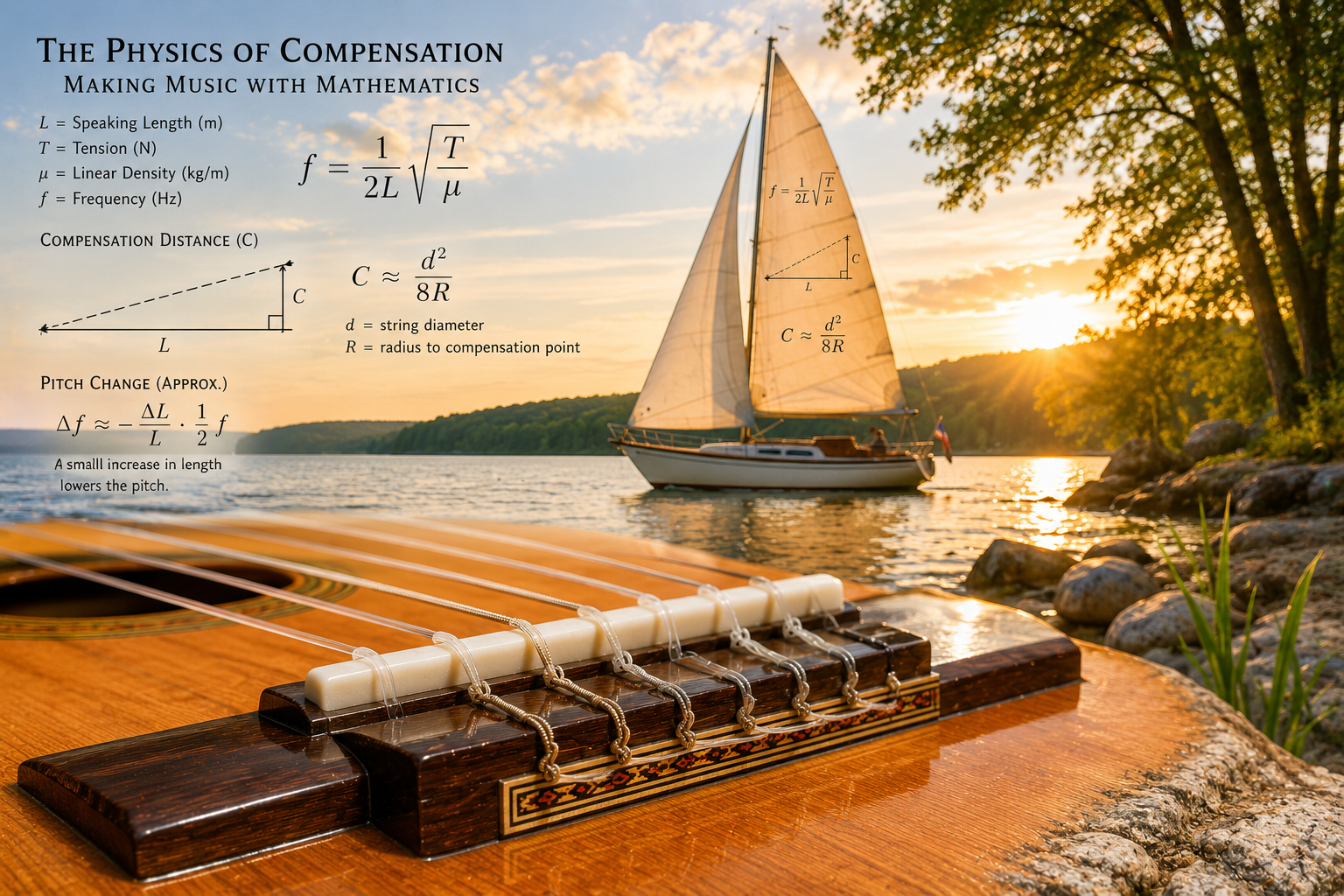
Roudhloff Melophonic Double Saddle (c. 1850)
[Neck]==================-----------------
        |--       <-- High strings
        |--\__    <-- Low, high-tension strings
Other builders took this separation of physical contact points even further. Around 1850, the French makers D. A. Roudhloff introduced the “Melophonic” guitar, which featured an innovative compensation bridge with two separate saddles.
The front saddle was straight, providing a crisp, short scale for the treble strings, while a second, angled saddle sat physically behind it to handle the higher physical tension and bending stiffness of the bass strings.
Q&A
Questions Players Ask About This Topic
Closing Thought
The Dance Between Wood and Wire
These historical milestones highlight a physical truth that modern builders still respect: on an acoustic instrument, achieving precise intonation is never just a matter of adding adjustment screws. It is a delicate, physical dance between the stiffness of wire, the elasticity of wood, and the acoustic requirement for lightweight strength.
Back to Top