
Guitar Technology • Modern Intonation Systems
The Electronic and the Mechanical: Taming the Guitar’s Temperament in the 21st Century
Modern manufacturing has achieved a level of geometric precision that historical luthiers could only dream of, yet the moment a human hand picks up a guitar, this static machine precision is immediately disrupted.
High-precision CNC mills can cut wood to within hundredths of a millimeter, and electronic strobe tuners can resolve pitch deviations down to a tenth of a single cent.
Yet different finger pressures, fluctuating humidity, and the physical wear of metal frets ensure that the guitar remains a dynamic, variable system. To bridge this gap, modern innovators have developed a suite of mechanical, geometric, and digital systems that push the limits of what a fretted instrument can achieve.
Section 1
The Industrial Pioneers: Fender and the Tune-o-matic
The foundation for user-adjustable mechanical intonation was laid in the mid-twentieth century with the rise of the solid-body electric guitar. Free from the acoustic weight restrictions of wooden soundboards, electric guitar designers could integrate robust metal hardware directly into their bridge designs.
In 1951, Clarence Leonidas “Leo” Fender patented his integrated bridge-and-pickup assembly, which eventually evolved into the 1954 Fender Stratocaster’s synchronized tremolo. This design introduced six independent metal saddles. Each string rested on its own physical block, which could be raised or lowered to adjust the action height, or slid forward and backward with an adjustment screw to physically alter the scale length.

Gibson Tune-o-matic Bridge (1954)
[Neck] ===== ==============
       |-- <-- Adjustable Screw -->
* Screws allow moving individual saddles without releasing string tension.
In parallel, Ted McCarty, the president of Gibson, designed and patented the Tune-o-matic bridge, introduced in 1954. The Tune-o-matic featured a die-cast zinc frame housing six small, movable saddles.
Crucially, McCarty’s design allowed a player to physically adjust the intonation of each string under full tension with a small screwdriver. This design became the dominant physical architecture for Gibson electrics and archtop guitars, proving that user-adjustable scale lengths were highly practical for mass production.
Section 2
Rewriting the Frets: Multiscale and True Temperament
While adjustable saddles resolved basic scale length compensation, they still left the straight metal frets untouched. In the late twentieth century, designers began to realize that the fretboard layout itself could be restructured to handle the physical properties of different strings.
In 1989, Ralph Novak patented the modern multiple-scale, or “fanned-fret,” fingerboard. Novak’s design gave each string its own unique, optimized scale length. The bass strings are given a physically longer scale length, which increases their tension and physical stiffness, while the treble strings maintain a traditional, shorter scale.
This physical separation ensures that the low-E string does not stretch excessively or experience a sharp pitch spike when plucked aggressively, while the high-E string remains easy to bend.

Fanned-Fret Fretboard:       True Temperament Fretboard:
=== / === / === / === [Nut]  === ~ === ~ === ~ === [Nut]
== / === / === / ===         == ~ === ~ === ~ ===
= / === / === / ===          = ~ === ~ === ~ ===
* Straight frets, angled scale. * Curved frets, individual string corrections.
An even more radical geometrical response emerged from Sweden with the development of the True Temperament system, championed by Anders Thidell and Paul Guy. True Temperament rejects the physical assumption that frets must be straight lines.
Recognizing that every string behaves differently at every single fret, the True Temperament system utilizes computer-milled, curved, “squiggly” frets. By physically adjusting the contact point for every individual note up and down the neck, True Temperament ensures that the physical pitch produced matches equal temperament exactly, resolving the physical string-stiffness errors that straight frets leave behind.
To maximize the accuracy of this curved physical grid, players must tune a True Temperament-equipped guitar to specific, predetermined physical offsets.
| Guitar String | Standard Musical Note | Target Physical Tuning Offset |
|---|---|---|
| String 1 (High) | E4 | −1 cent |
| String 2 | B3 | −1 cent |
| String 3 | G3 | +4 cents |
| String 4 | D3 | +2 cents |
| String 5 | A2 | 0 cents (Reference) |
| String 6 (Low) | E2 | −2 cents |
Section 3
The Constant Tension Miracle: EverTune
While True Temperament restructures the fretboard, the EverTune bridge uses mechanical physical feedback to stabilize tuning. EverTune is an all-mechanical, spring-balanced bridge system.
Rather than anchoring the string to a fixed metal post, each string on an EverTune guitar is anchored to an independent, pivoting metal saddle module that is balanced against an internal mechanical spring.
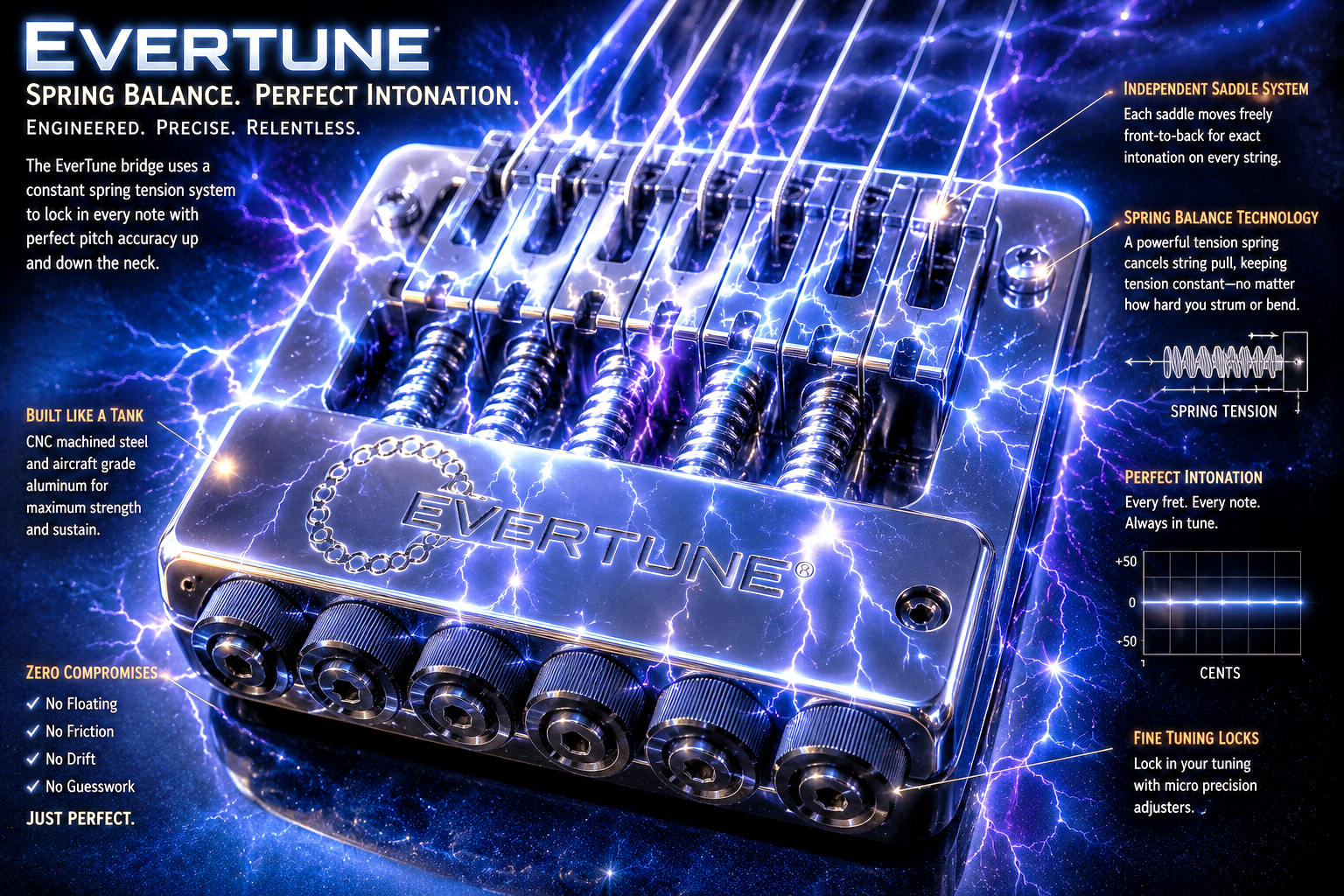
EverTune Spring Balance System
String Tension (T) <===========||===========> Spring Force (F)
* In Zone 2, any change in neck expansion or player pressure is
  absorbed by the spring, maintaining a constant physical pitch.
The system operates across three distinct mechanical “Zones” that are controlled by the physical tension of the tuning machines on the headstock.
- Zone 1: The spring is completely compressed. The string behaves like a traditional hardtail bridge, and turning the tuning peg directly raises the pitch.
- Zone 2: The spring enters its active, floating range. In this zone, turning the tuning peg on the headstock does not change the physical pitch of the string. The internal spring dynamically expands or contracts to absorb any physical changes in the neck’s wood or the string’s length, maintaining absolute constant tension and pitch.
- Zone 3: The spring reaches its physical travel limit. The string exits the constant-tension zone and begins to raise in pitch again as the tuning peg is turned.
By tuning the string to the exact boundary point where Zone 2 meets Zone 3, a player like Devin Townsend can enjoy absolute pitch stability when chorded heavily, while still being able to execute wide, expressive pitch bends.
However, this mechanical system comes with physical constraints. Prior to August 2019, the EverTune saddle holes could only fit strings up to a .074 gauge. While the factory subsequently widened the hole to fit up to a .080, and sometimes .084 gauge, very thick low-tuned strings can still run out of physical saddle travel, preventing them from intonating properly unless the entire bridge is physically installed one millimeter further back. Additionally, the system is physically optimized for flexible wound strings rather than stiff, thick unwound strings, such as a solid G-string, which can resist the spring’s mechanical pivot.
Section 4
Rebuilding the Neck Joint: Taylor’s NT and Action Control Necks
While bridge designs have evolved, the physical connection between the neck and the body remains a major point of physical stress. Under the constant pull of six steel strings, the neck joint of an acoustic guitar will slowly pivot forward over several decades, throwing the action height and the scale geometry out of alignment.
To resolve this on traditional glued-in dovetail joints, a luthier must execute a costly, invasive physical neck reset, which involves steaming the glue joint apart and physically shaving the neck heel down.
In 1999, Bob Taylor revolutionized acoustic manufacturing by introducing the patented NT, or New Technology, neck. Instead of gluing the neck to the soundboard, Taylor designed a bolt-on joint where the wooden neck extends in one continuous piece all the way to the 19th fret, fitting into a precision-milled pocket in the body. The physical angle of the neck is set using custom-machined shims.
If the neck angle shifts over time, an authorized technician simply bolts the neck off, swaps out the shims to correct the angle, and bolts it back on, restoring playability without altering the structural integrity of the guitar.
In April 2025, Taylor master builder Andy Powers took this mechanical adjustability a step further with the patented Action Control Neck joint. Exclusive to Taylor’s ultra-premium Gold Label Collection, this long-tenon joint completely eliminates the need for physical shims.
By inserting a standard 1/4-inch nut driver directly through the soundhole, a player or technician can micro-adjust the neck angle and string height in seconds under full string tension. This allows touring musicians to instantly adapt their instrument’s physical geometry to shifting climates, or transition from a low-action fingerstyle setup to a high-action slide setup without changing strings or saddles.
Section 5
The Digital Guardian: Plek Technology
The final stage of modern guitar optimization has shifted from artisanal hand-shaping to computer-guided digital metrics. Developed by Gerd Anke, the Plek Pro and Plek Station machines have transformed post-finish fret dressing into a precise data-driven workflow.
Because wood is an organic, elastic material, a guitar neck will bend and twist in unpredictable ways once it is subjected to the immense physical pull of tuned strings. Traditional hand-leveling of frets is typically performed on an unstrung neck, meaning the luthier is guessing how the wood will react once the strings are re-tensioned.
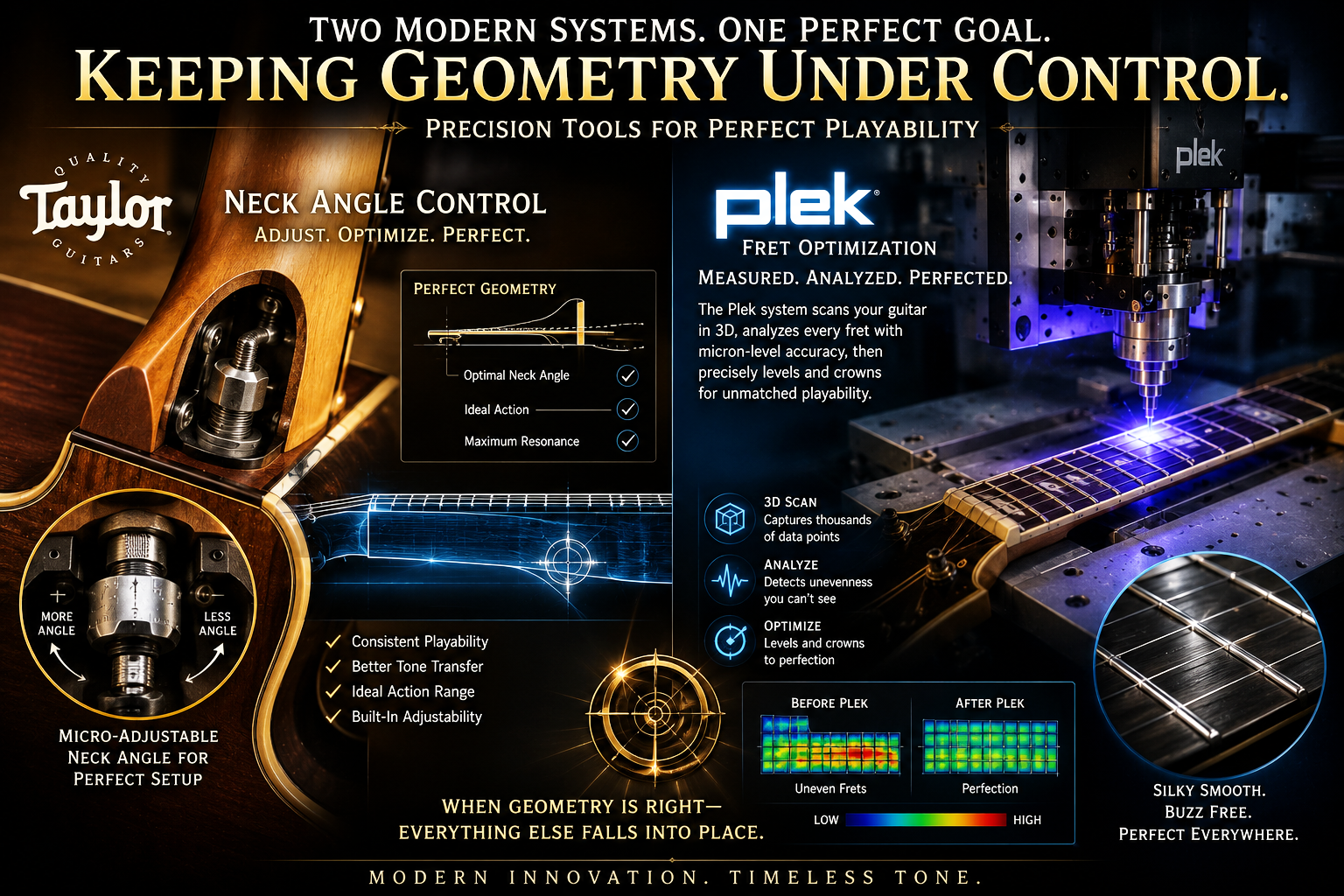
The Plek Scan Visualizer (Under Tension)
========================================= [Nut]
~~~~  Actual current fret heights (uneven)
----  Target optimum fret contour calculated by Plek
=========================================
* Computer-guided cutters shave the frets to match the calculated curve.
The Plek machine solves this by performing its physical measurements under real or simulated string tension. For high-volume factories where instruments must be processed without strings, the Plek system uses a pneumatic String Tension Simulation module, which applies physical air pressure to the neck to mimic string pull.
Once inside the chamber, a touch-free laser scanner measures the entire neck geometry at a resolution of 0.01 mm, completing a full scan in about two minutes. The software processes this data to generate a highly detailed virtual representation.
Technicians utilize Virtual Fret Dress technology to view several color-coded metrics on-screen: the blue line represents the target physical relief curve of the fingerboard, the wavy red line represents the actual current heights of the frets, the green curve represents the recommended target fret height calculated to eliminate buzzing, and the straight green and red lines represent the target versus actual string action heights.
By diagnosing these variables virtually, the technician can simulate physical adjustments on-screen before any actual cutting occurs. Once finalized, the machine’s robotic cutters shave and recrown the metal frets with a precision of 0.01 mm, cutting away the absolute minimum amount of fret material necessary to achieve buzz-free, ultra-low action.
This digital precision is now paired with advanced academic modeling, such as the 2023 3D modeling project at TU Dresden, which used 2000 CT scans at 1 mm spacing to capture internal acoustic body geometries, and neural networks to predict the physical properties of spruce tonewood.
Plek Pro & STS
Robotic, computer-guided scanning and fret dressing under real or simulated string tension.
Taylor Action Control
A mechanical neck-angle adjustment system controlled through the soundhole under tension.
EverTune Bridge
A spring-loaded bridge system that absorbs string elongation and neck flex to maintain constant pitch.
True Temperament
Computer-milled curved fret rods that correct scale length per fret and per string.
Q&A
Questions Players Ask About This Topic
Closing Thought
The Guitar Remains a Beautiful Compromise
These advanced mechanical, digital, and structural systems represent the current peak of physical innovation. By replacing artisanal estimation with computer-guided scans, advanced physics modeling, and spring-loaded constant tension, modern luthiers have successfully managed the physical limitations of the guitar.
While the guitar remains a beautiful compromise of physical forces, these tools ensure that this compromise is more tightly controlled, more reliable, and more playable than ever before.
Back to Top