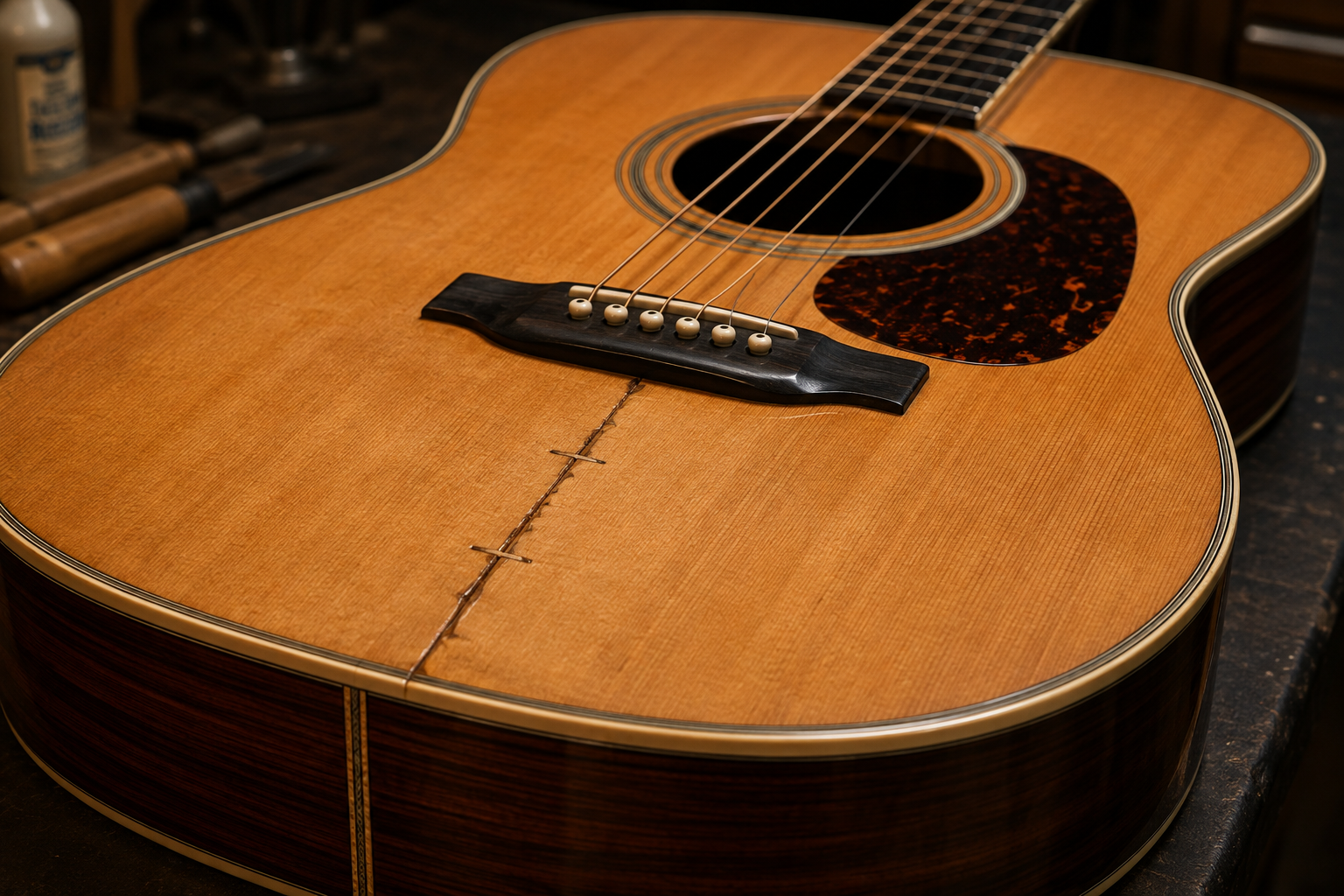
Acoustic Guitar Repair • Wood Science • Structural Diagnosis
Why Do Acoustic Guitar Tops and Sides Split?
Most acoustic guitar cracks are not mysterious failures and they are rarely caused by age alone. They are the visible end of a mechanical story involving moisture, wood movement, braces, glue joints, bridge load, grain direction, temperature, construction, and time.
A crack may look sudden. The stress that created it often was not.
When an acoustic guitar top or side splits without being dropped, the owner naturally asks the same question: Why now? The guitar may have been fine last week. It may have survived ten winters. It may never have left the house. Yet a line has opened beside the bridge, along the center seam, down a side, or beside a brace.
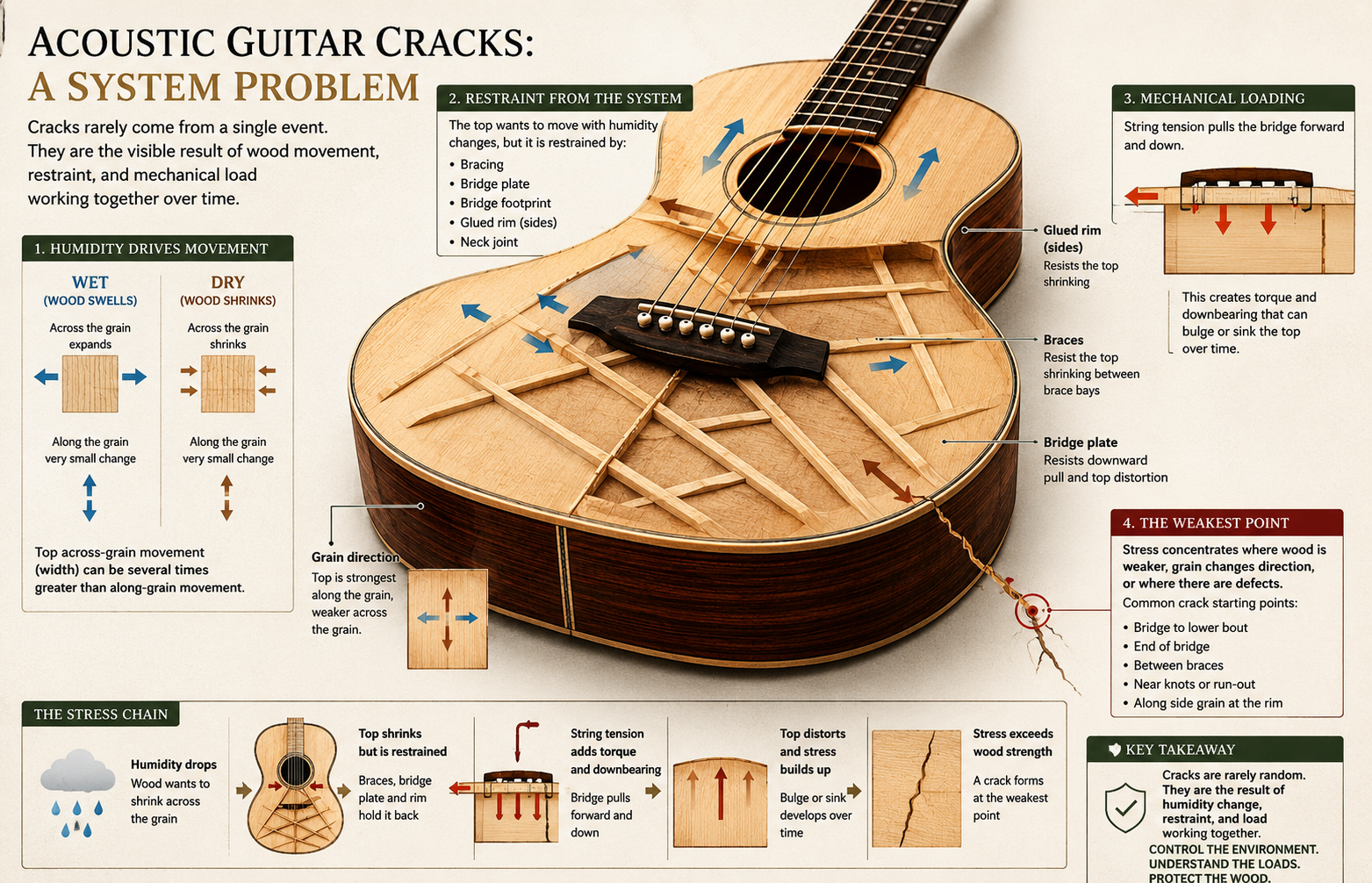
The best answer usually comes from thinking of the instrument as a system. Solid wood continually exchanges moisture with the surrounding air. As its moisture content changes, it wants to change dimension—especially across the grain. But a guitar plate cannot move freely because it is restrained by braces, linings, blocks, bindings, the bridge, glue joints, and neighboring pieces whose grain may run in another direction. At the same time, the strings keep loading the bridge and bending the top.
Eventually the weakest location may release. Sometimes the wood fractures. Sometimes the center seam opens. Sometimes a brace comes loose. Sometimes the bridge begins to lift. The visible crack is often the final event in a much longer chain.
Section 1
The First Principle: Cracking Is Usually a System Problem
A solid-wood acoustic guitar is an unusually demanding use of wood. The top may be only a few millimeters thick, yet it has to remain light enough to vibrate and strong enough to support years of string load. The sides are thin, bent into shape, and locked between the top and back. Braces cross grain directions. The bridge concentrates load in one area. Glue joints are expected to stay intact while all of these parts respond to changing humidity and temperature.
That means a crack is rarely explained well by one sentence such as “the wood dried out,” “the guitar got old,” or “the strings pulled too hard.” Those descriptions may point toward part of the problem, but they do not describe how stress reached the location that finally failed.
A more useful sequence is:
This is why two guitars in the same room can respond differently. One may open at the center seam. Another may split beside a brace. A third may keep the wood intact but release a brace or bridge joint. The place that fails first is simply the part of that particular structure with the least remaining margin.
Section 2
Humidity: Why a Dry Guitar Can Literally Pull Itself Apart
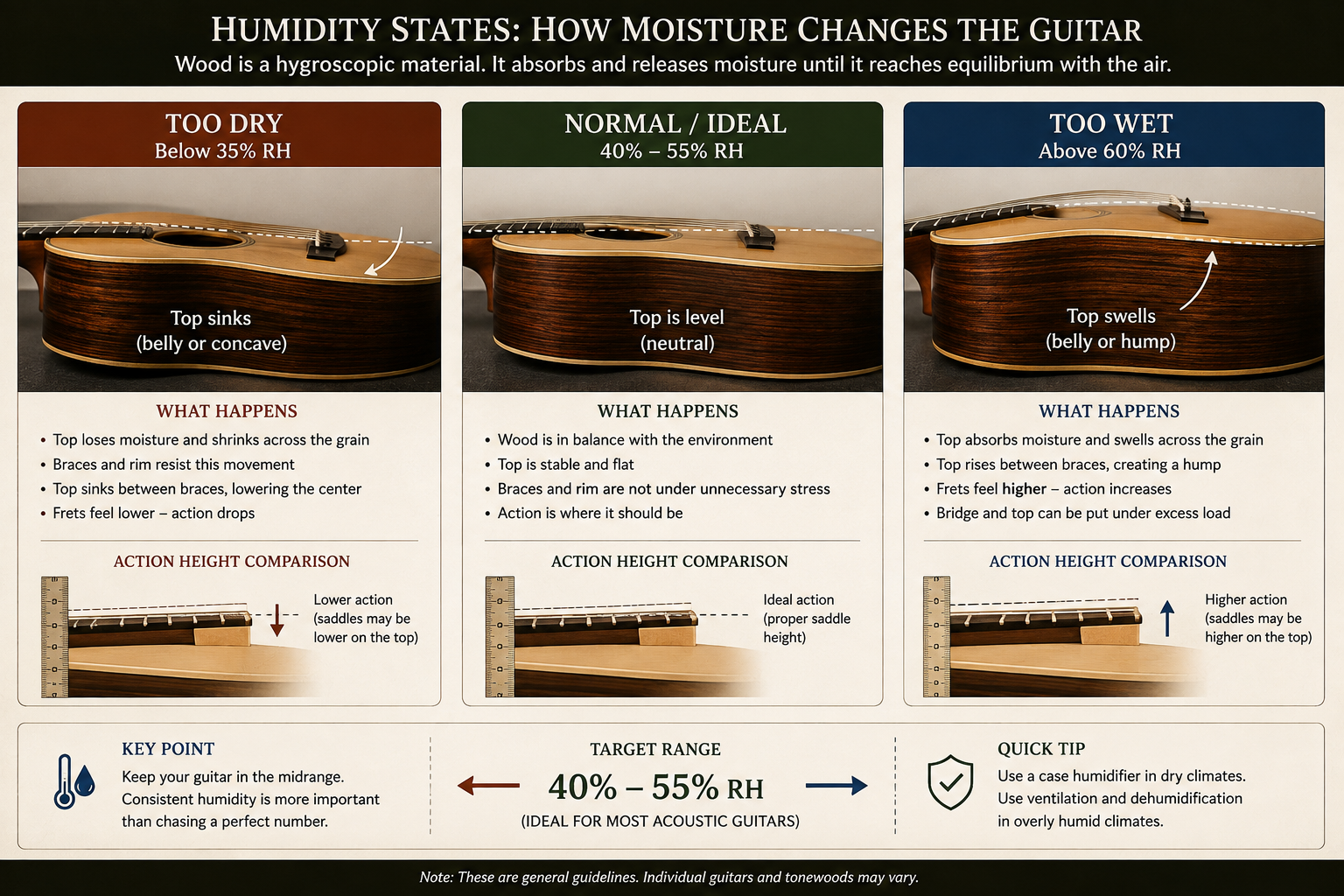
Wood is hygroscopic. It does not become permanently dry simply because it was seasoned before construction. It continues to exchange water vapor with the surrounding air throughout the life of the instrument. When relative humidity falls, wood loses moisture and contracts. When humidity rises, it gains moisture and expands.
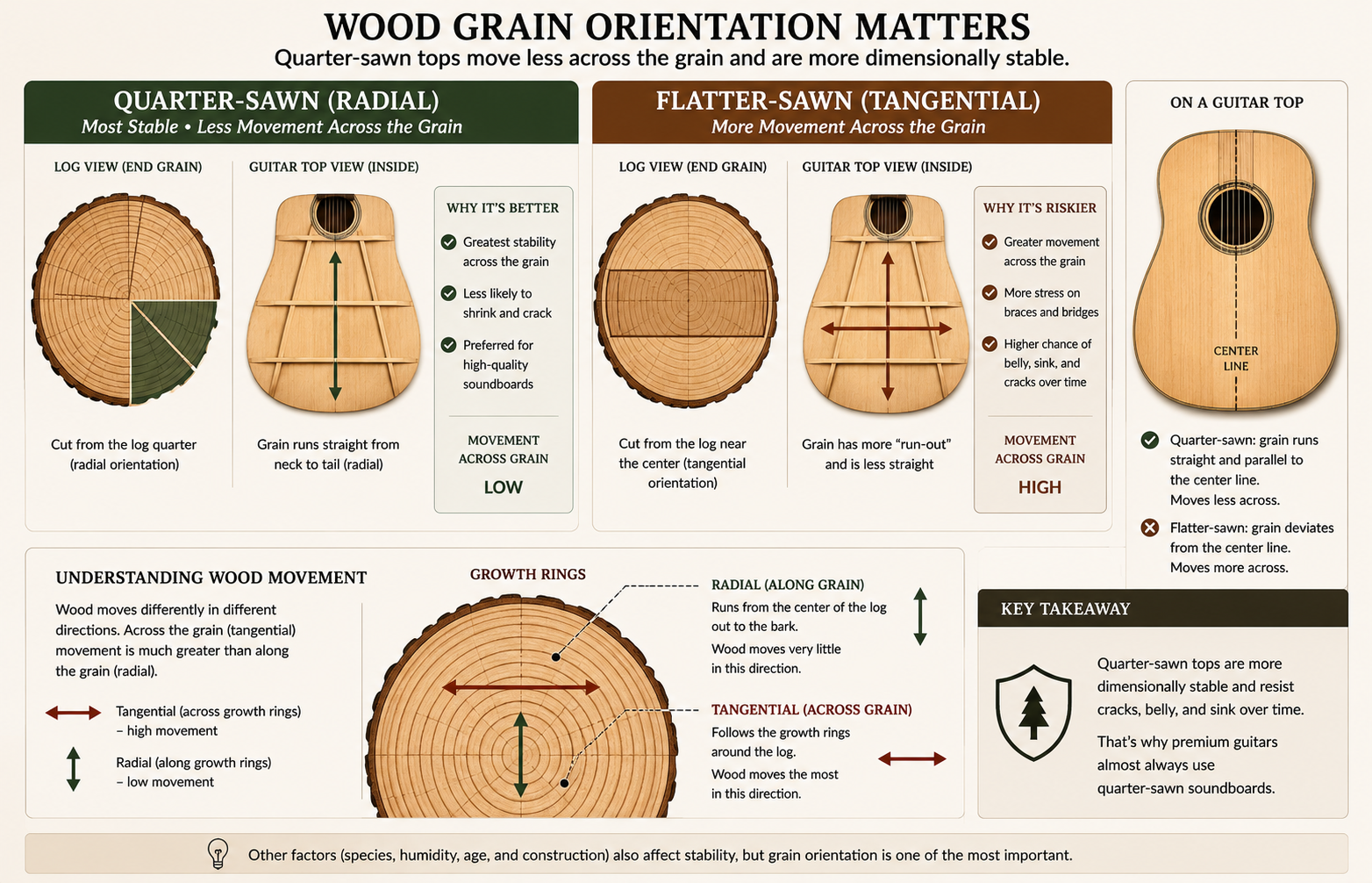
The important detail is that wood is anisotropic: it does not move equally in every direction. In normal straight-grained wood, dimensional change along the fibers is small. Movement across the grain is much larger. Tangential movement—roughly parallel to the growth rings—is ordinarily greater than radial movement, which is one reason well-quartered wood is prized for thin instrument plates.
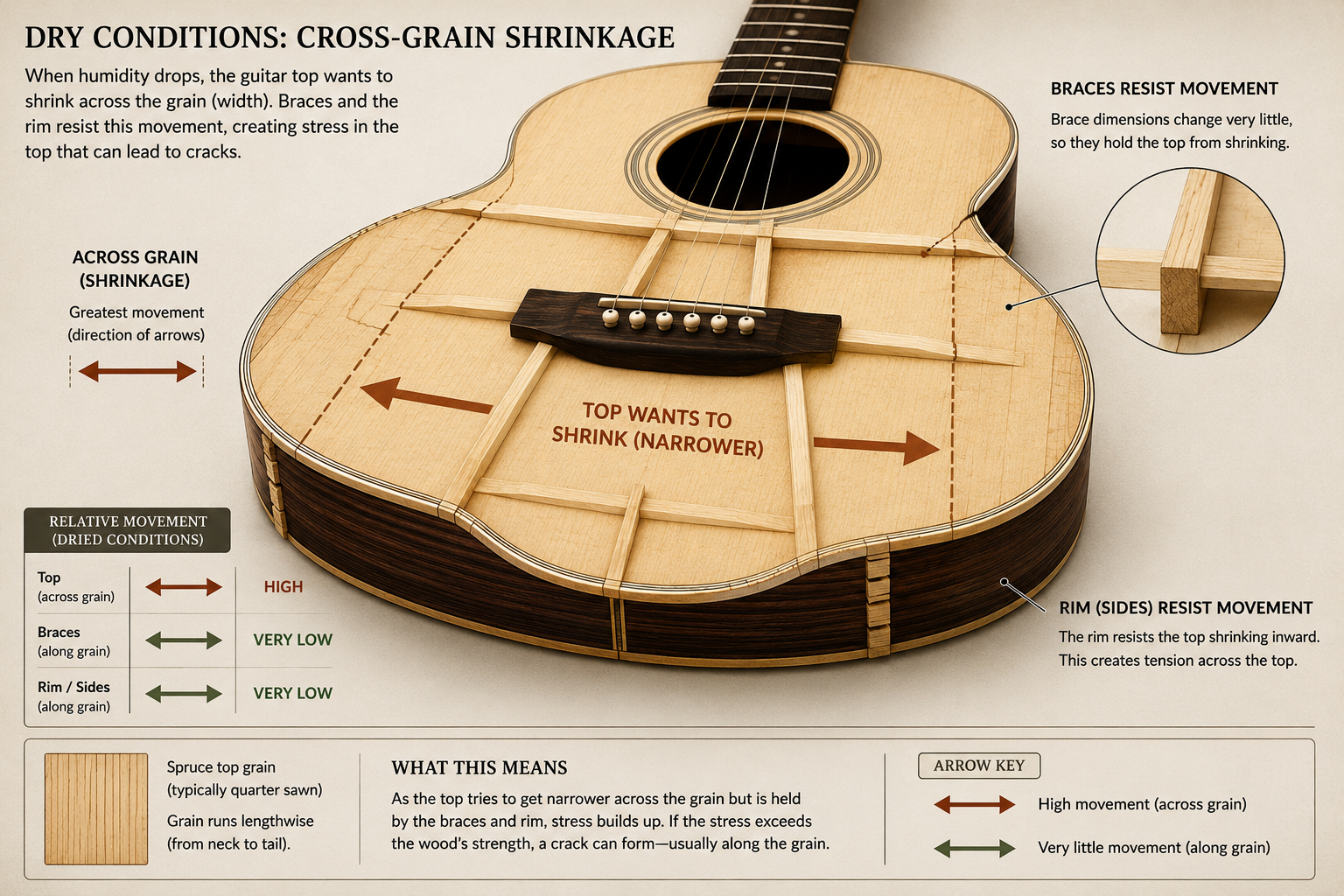
Now picture a spruce top that wants to become slightly narrower during a dry heating season. If it were an unattached board, it could simply shrink. But it is not free. Its perimeter is glued to the rim and linings. Braces cross the grain. The bridge spans part of the lower bout. The center seam has to remain bonded. When the top tries to contract and the structure resists, part of that dimensional movement becomes internal stress.
Taylor gives a useful scale example: a 16-inch spruce plate conditioned near 47% relative humidity can lose almost one-eighth inch of width if taken to roughly 30% RH while unrestrained. A completed guitar cannot surrender that width freely, so the stress has to go somewhere.
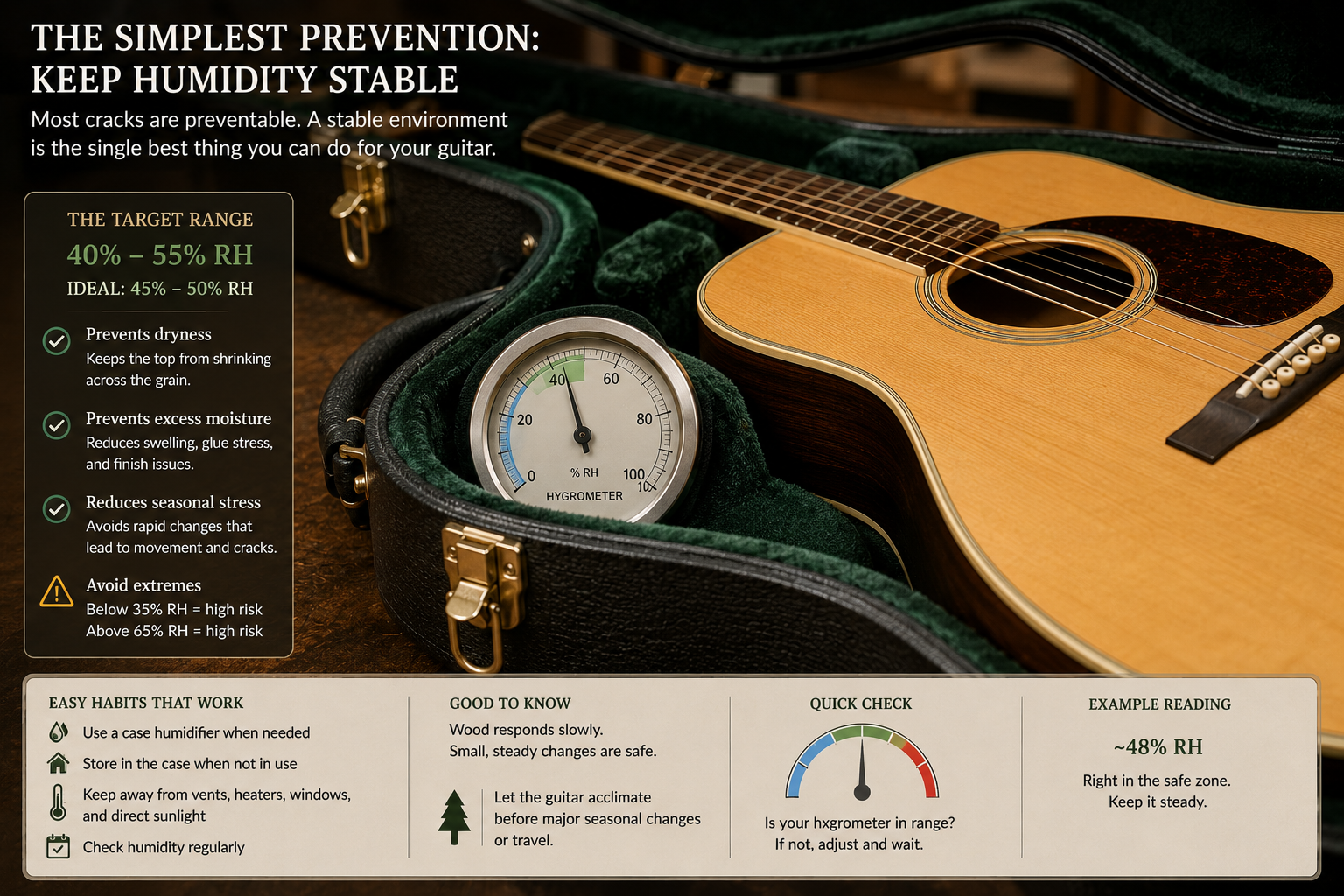
Both Taylor and Martin recommend a practical storage range around 45–55% relative humidity for their acoustic instruments. That range should not be treated as a magical fracture boundary. A guitar does not explode at 44% or become waterlogged at 56%. Risk depends on how far conditions move, how long they remain there, how quickly they change, and the design and history of the instrument.
Section 3
Braces Can Protect the Top and Stress It at the Same Time
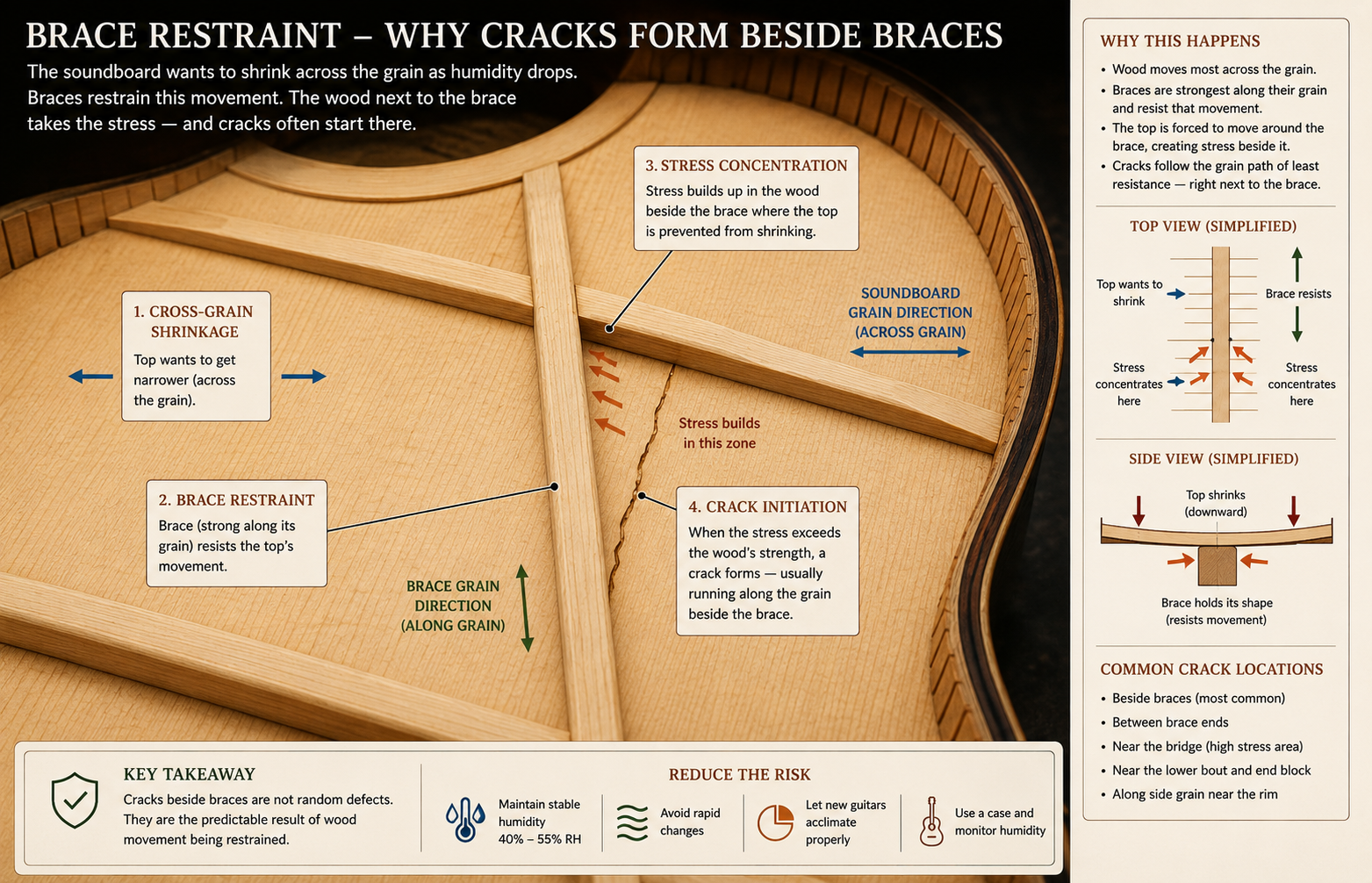
Bracing has two jobs that occasionally work against each other. First, braces strengthen the soundboard and distribute bridge load over a larger area. Without them, a thin acoustic top could not resist string tension for long. Second, because brace grain usually runs along the brace, a brace changes very little in length compared with the soundboard’s across-grain movement.
In dry conditions the top wants to contract across its grain while a cross-grain brace resists that contraction. Stress therefore rises in the top immediately beside the brace and in the glue joint connecting the two pieces.
Which one releases first depends on the actual instrument. A very strong glue joint can hold while the spruce beside it fractures. A marginal brace joint may release instead, creating a loose brace. That loose brace then reduces local stiffness and allows the plate to flex more, which can start a second problem even though the first release may have temporarily reduced the moisture stress.
This is also why there is no meaningful “crack-proof” brace pattern by name alone. X-bracing, fan bracing, scalloped braces, tapered braces, and other layouts all work as part of a larger system. Plate thickness, brace height, wood species, body size, bridge and bridge-plate dimensions, string load, and grain quality determine the actual structural reserve.
Section 4
Bridge Torque, Long-Term Load, and the Question of “Bellying”
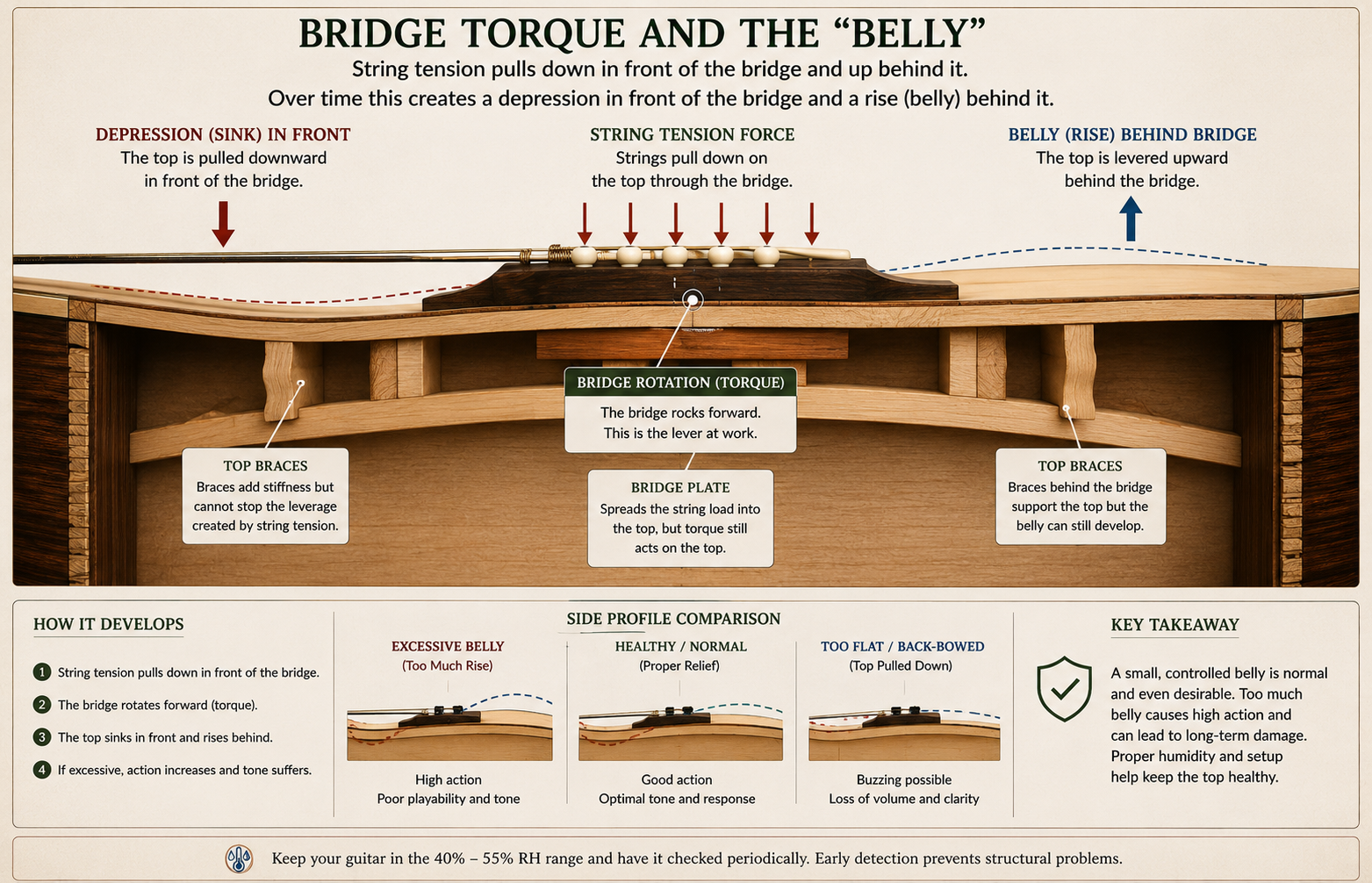
The strings do more than pull lengthwise on the guitar. Their line of action sits above the top and saddle, so the bridge experiences an overturning tendency. The rear of the bridge tends to lift while the area immediately in front tends to be pushed downward. The thin soundboard responds by bending.
That familiar combination—some depression in front of the bridge and some rise behind it—is not automatically a defect. A degree of belly is normal on a working steel-string acoustic guitar. The important diagnostic question is whether the geometry is changing or whether it is accompanied by other evidence.
Concern rises when belly becomes progressively larger, strongly asymmetric, paired with rising action, accompanied by a bridge that is lifting or rotating, or associated with a crease, loose brace, thin bridge plate, excessively tall saddle, or previous structural repair.
Time matters because wood under sustained load creeps. In plain language, a structure held under load can slowly change shape even when the load itself does not increase. Changing moisture content can amplify this long-term deformation through what wood science calls mechanosorptive creep. That is one of the reasons a guitar can look normal for years and then slowly develop more bridge rotation without any single dramatic accident.
String gauge matters for the same reason. The research behind this article used D’Addario’s published tension values as a concrete example: one 12–53 phosphor-bronze light set totals roughly 160.5 pounds of static string tension at its specified pitches, while a 10–47 extra-light set totals about 133.2 pounds. That is more than a 27-pound difference between two ordinary commercial sets. Those exact numbers are product-specific, but the mechanical lesson is broader: changing string load changes the demand on the structure.
Section 5
Causes, Characteristic Signs, and Remedies
The research table distinguishes primary causes from contributing factors. Several often occur together—for example, a dry winter may initiate a top crack at a point already weakened by grain runout, while bridge torque keeps the crack mechanically active.
Click any cause below to expand the complete table entry. All four original fields are preserved: cause, mechanical pathway, typical signs, and most useful response.
Wood loses bound water and contracts across the grain. Braces, rim and bridge restrain contraction, producing cross-grain tension and joint shear.
Sunken/flatter top, lower action, protruding fret ends, center-seam opening or grain-following top/back cracks. Taylor identifies these as characteristic dry-guitar symptoms.
Stabilize near roughly 45–55% RH, preferably in the case; raise humidity gradually and monitor with a hygrometer before structural repair.
Expansion and contraction are repeated. Cyclic strain occurs in wood and joints; under sustained load, changing moisture also promotes mechanosorptive creep.
Crack that closes in summer and opens in winter, recurrent brace noise, slowly worsening belly or seam movement.
Reduce the amplitude of yearly RH swings rather than treating only the visibly dry season; repair once geometry has been stabilized.
Persistent low moisture content keeps the plate dimensionally contracted and can hold it in tensile stress for months or years.
Persistently flat/sunken top, open seams, repeated cracks, sharp fret ends; old repairs may reopen.
Rehumidify slowly, establish a stable storage climate, then evaluate every crack and brace after the instrument has equilibrated.
Wood swells; geometric distortion and high joint strains develop. Taylor reports that prolonged high humidity can contribute to glue-joint failure and finish lifting.
High action, swollen or distorted top/back, pronounced belly, dull response, lifted finish or failing joints.
Dehumidify gradually; avoid assuming the solution is lower string gauge or neck adjustment until body moisture is corrected.
Sustained string load produces bridge rotation and plate bending; creep can increase deformation with time.
Growing belly behind bridge, depression in front, tilted bridge/saddle, rising action, crease near bridge.
Check braces, bridge plate, bridge adhesion, saddle geometry, plate thickness and humidity before attempting to flatten the top.
Bond-line peel/shear, poor original adhesion, heat/moisture exposure, wood-fiber failure, or excessive deformation progressively separates the bridge.
Visible gap under bridge edge, finish distortion around bridge, accelerating top rotation.
Treat promptly; do not simply inject glue into an unprepared gap. The old bond surfaces and failed wood must be diagnosed and properly prepared.
Cross-grain restraint from humidity movement creates glue-line shear; string-induced plate bending adds cyclic and static load.
Rattle/buzz, local top softness or abnormal flex, abrupt change in belly, crack adjacent to a brace.
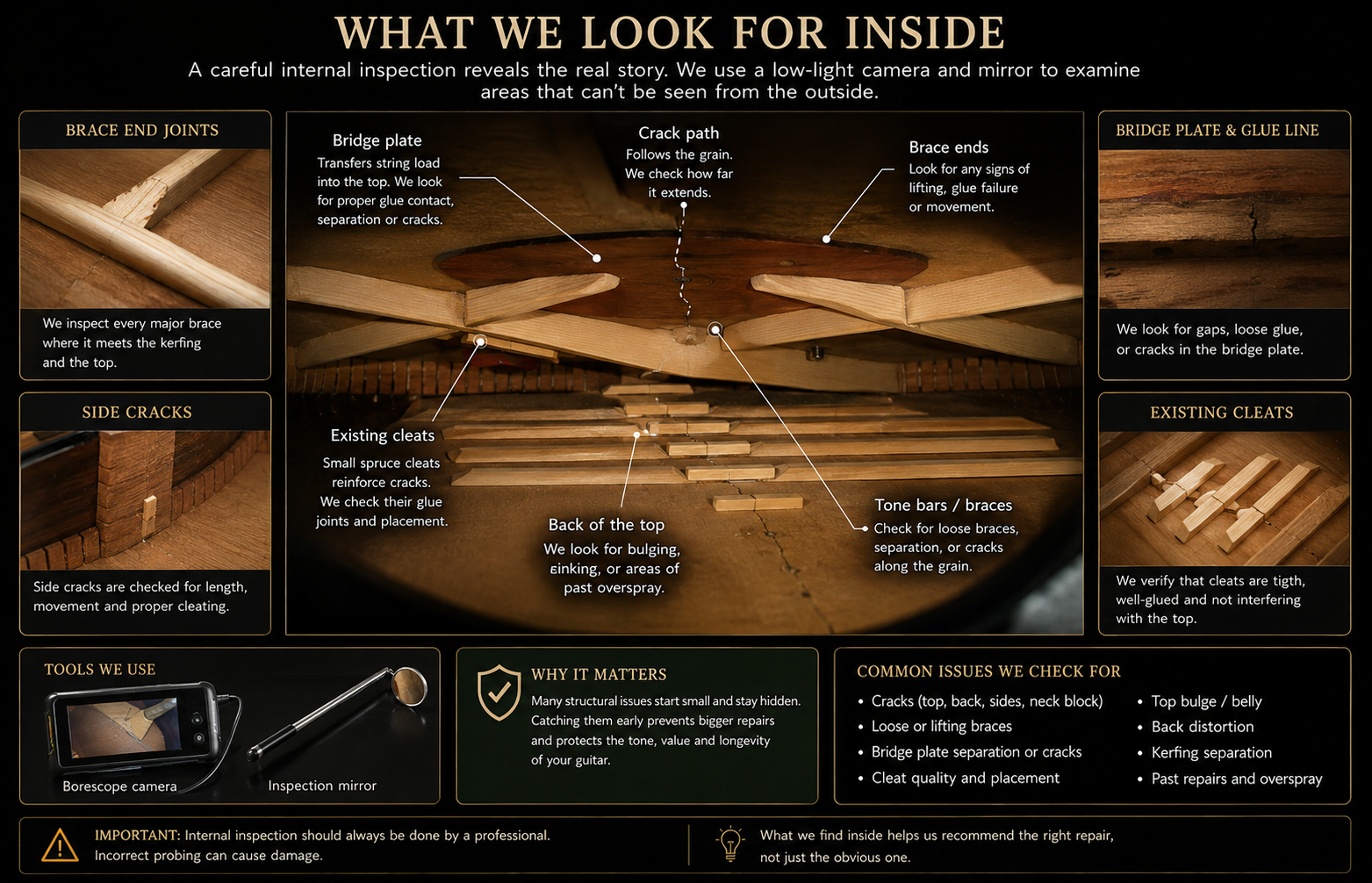
Inspect internally with mirror/borescope and controlled probing by a luthier; reglue only after humidity and mating surfaces are corrected.
Differential shrinkage, defective wetting, starved joint, contaminated surface, or moisture cycling exceeds bond capacity.
Straight opening exactly along a manufactured joint, sometimes without fractured fibers crossing the line.
Distinguish a failed seam from a wood crack; stabilize moisture, clean/prepare the joint correctly, then reglue and reinforce only as appropriate.
Greater tension raises the static load transmitted through bridge and neck. A D'Addario 12–53 set totals about 160.5 lb versus about 133.2 lb for its 10–47 set at specified pitches—a product-specific difference of about 20%.
Belly or bridge rotation increases following gauge/tuning change; old/lightly built instrument begins deforming.
Use the string range for which the instrument was designed. Consult a luthier before a substantial permanent increase in tension on a lightly built or vintage instrument.
Fibers no longer carry stress along the strongest direction; abnormal longitudinal shrinkage and local stress concentrations can arise. USDA notes severe strength penalties from slope/cross grain and abnormal shrinkage in reaction or juvenile wood.
Crack follows grain runout, localized distortion, split beginning at a visibly irregular grain area.
Select straight, well-quartered stock for highly stressed thin plates and reject hidden drying checks, severe runout and reaction wood during manufacture.
Incorrect wood MC at assembly, plates/braces too light for load, damaged glue surfaces, inadequate joint fit, hidden drying checks or residual stress leave little safety margin.
Early failure without extreme climate; repeated problem at the same structural feature; abnormal asymmetry from new.
Diagnose the underlying geometry/material rather than repeatedly sealing the crack. A reinforcement or brace redesign may be required.
Rigid patches, excessive cleat mass, wrong grain direction, poorly fitted splines, contaminated joints or unremoved old adhesive create new stiffness discontinuities and stress concentrations. Bond quality is strongly dependent on clean, freshly prepared, well-matched surfaces.
Crack reopens beside—not necessarily through—the old repair; large stiff patch; glue residue; distorted plate.
Remove or revise failed work where practical; restore alignment and use minimally sufficient reinforcement with compatible grain and adhesive.
Wood and coating systems have different thermal expansion rates; fast temperature changes create transient stress. Prolonged heating can also produce net shrinkage because moisture loss commonly exceeds direct thermal expansion.
Finish checking after bringing a cold guitar rapidly into warmth; glue or geometry problems after severe heat exposure.
Let a cold instrument warm slowly in its closed case; never leave it in a hot vehicle or near heaters.
The coating cannot accommodate differential thermal or dimensional movement. Nitrocellulose is particularly known for fine checking during sharp temperature changes.
Network of fine surface lines, often crossing grain and continuing where the underlying wood is intact.
Determine whether the line exists only in the finish before treating it as structural damage. Avoid rapid thermal transitions.
UV photodegrades exposed lignin and coatings at the surface; direct sun also heats the instrument and can drive moisture loss and differential expansion.
Fading/yellowing, finish degradation and localized heating; structural cracking usually involves accompanying thermal/moisture stress rather than UV alone.
Keep the instrument out of prolonged direct sun, especially behind glass or in vehicles.
Wood chemistry and hygroscopic response change slowly with age, while sustained mechanical loading and moisture cycling accumulate deformation. Research on musical-instrument wood confirms measurable aging effects but not a fixed failure age.
Gradually increasing bridge rotation, old finish checking, long-stable defect finally becoming active.
Judge the actual geometry, moisture history, joints and repairs; do not diagnose “old wood” by calendar age alone.
Decay fungi attack structural cell-wall polymers and can greatly reduce mechanical strength, sometimes before dramatic visual destruction is evident.
Soft/punky wood, discoloration, musty environment, cubical or fibrous decay, loss of stiffness.
Eliminate moisture source, isolate the instrument, identify extent of sound wood and obtain conservation/luthiery assessment.
Tunnels remove load-bearing material and create severe local stress concentrations. USDA notes that residual strength cannot reliably be inferred merely from the appearance of insect holes.
Exit holes, frass/powder, internal galleries, local weakness.
Isolate from other wooden objects and have the infestation professionally identified and treated before structural repair.
Acidic and oxidizing pollutants can attack wood, coatings and other heritage materials; deposited smoke/oils can age finishes and contaminate repair surfaces. Direct evidence for pollutants alone causing guitar plate cracks is limited.
Finish discoloration, grime, odor, surface embrittlement or corrosion of metal parts; usually no unique “pollution crack” signature.
Control storage air quality, smoke and condensation; clean contaminated repair surfaces appropriately. Treat pollution as a secondary risk unless exposure is severe.
Section 6
Finish Checking Is Not the Same Thing as a Wood Crack
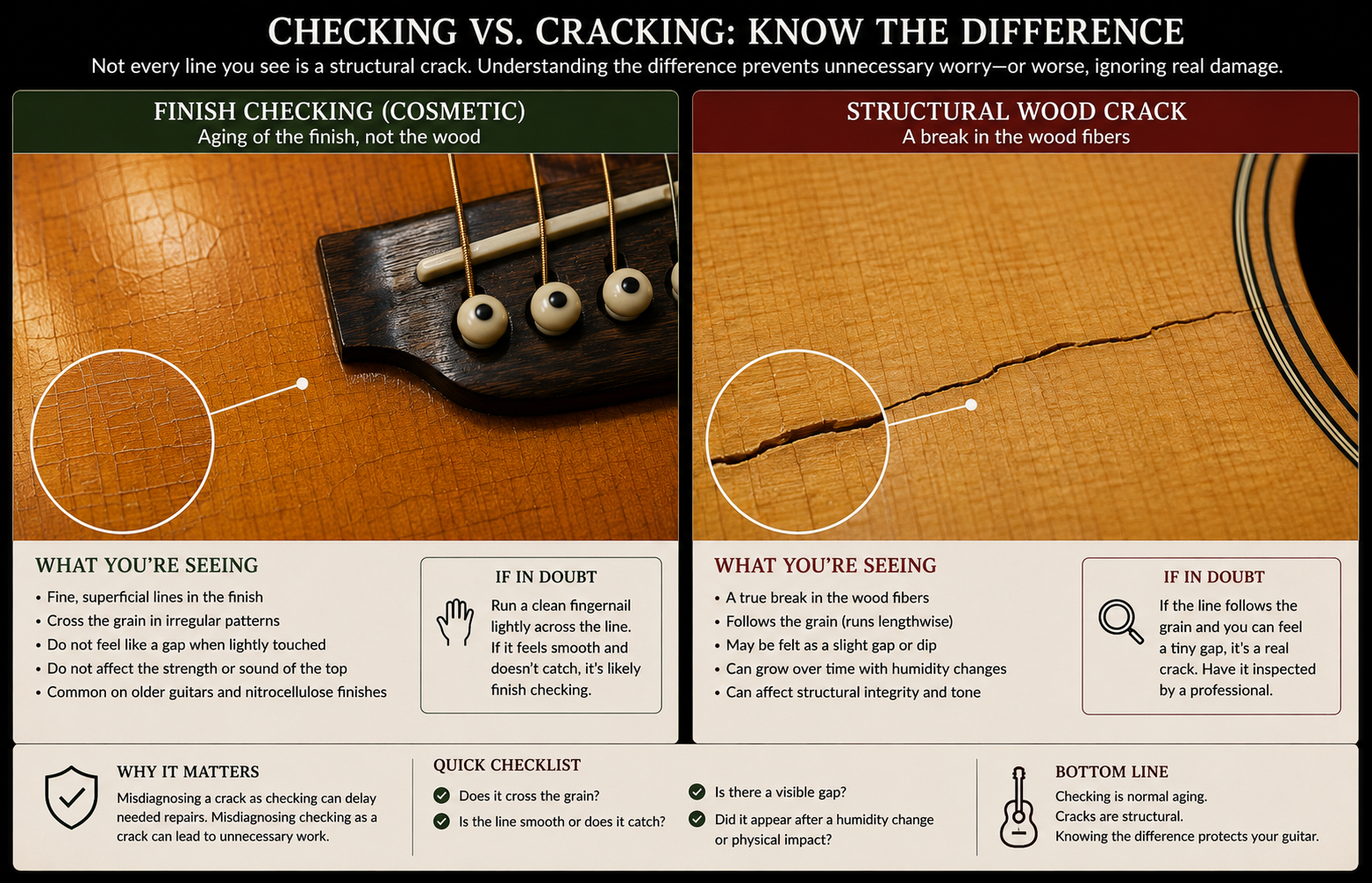
This distinction prevents a lot of unnecessary panic. A finish is a film on the surface. Wood is the structure beneath it. A sharp temperature change can make certain finishes—nitrocellulose lacquer is especially known for this—develop fine checking lines even when the wood remains intact.
Finish checking may cross the grain or appear as a fine network because the coating itself is fracturing. A true wood crack more often follows the fibers and may open or close slightly with humidity. It may also be visible from inside the body.
The two can coexist. A moving wood crack can fracture the finish above it. An old finish check can conceal or imitate a structural split. The repair method changes completely depending on which layer actually failed, so the first job is classification rather than glue.
Section 7
How the Common Tonewoods Differ
No species can honestly be labeled simply “the most crack-prone” without specifying what kind of cracking is meant. Dimensional stability and fracture resistance can point in different directions, while cut orientation, plate thickness, grain runout, brace geometry and the individual board can matter as much as species name.
Click a tonewood to expand its complete comparison entry. The original role, material evidence, and crack-risk interpretation are all included.
Predominantly tops
USDA gives about 4.3% radial and 7.5% tangential green-to-oven-dry shrinkage. It is light, comparatively stiff for its weight and has moderately low shock resistance. USDA specifically lists guitar faces among its uses.
Moderate-to-high practical dry-crack exposure as a top, not because spruce is “bad” wood but because the plate is extremely thin, wide, restrained and bridge-loaded. Well-quartered stock reduces movement relative to flatsawn stock.
Classical and some steel-string tops
About 2.4% radial and 5.0% tangential shrinkage, clearly lower than Sitka in these USDA data; it is also lighter, lower in strength and lower in shock resistance.
Lower moisture-driven dimensional movement than Sitka, but lower damage tolerance. Cedar is therefore not automatically more humidity-crack-prone, although thin cedar can be more susceptible to local splitting, crushing or damage around stress concentrators.
Backs/sides, necks, sometimes tops
USDA data for Honduras mahogany give roughly 3.0% radial, 4.1% tangential and 7.8% volumetric shrinkage and rate movement after manufacture as small.
Relatively favorable dimensional stability. All else equal, well-cut mahogany backs and sides generally generate less moisture-movement stress than high-shrinkage alternatives. Thinness, bent-side stresses and grain defects can still produce long splits.
Mainly backs and sides
USDA mechanical data show Indian and Brazilian rosewoods are much denser than spruce/cedar; Indian rosewood is listed near specific gravity 0.75 and Brazilian near 0.8 in the cited test data. Rosewoods also contain substantial heartwood extractives.
Species-specific rather than universally high or low. Dense rosewoods can be made into thin stiff plates, and a crack can propagate sharply once initiated. Extractive-rich surfaces also demand good adhesive preparation. It is not justified to rank every “rosewood” above every other species for humidity cracking because Dalbergia species differ materially.
Backs/sides; occasionally other parts
Maple varies substantially. USDA values include about 4.8% radial/9.9% tangential for sugar maple, while bigleaf maple is approximately 3.7%/7.1%. Sugar maple is strong, hard and shock resistant but has relatively large shrinkage.
Potentially high dimensional movement, particularly in hard/sugar maple and flatsawn material, but comparatively strong wood can resist crack propagation. Grain orientation becomes especially important.
Section 8
Failure Timelines and Why Damage May Appear Years Later
Time to failure is governed more by severity × duration × restraint × existing defects × mechanical load than by instrument age. Some changes can appear in hours; others accumulate through seasons, years, or decades.
Click a time scale to expand the complete table entry. Each entry keeps the original failure mode, mechanical explanation, and interpretation.
Finish checking after abrupt cold-to-warm transition; heat-softened/heat-stressed joints under extreme conditions
Coating and wood respond at different rates; rapid temperature change creates transient strain. Severe heating simultaneously accelerates moisture loss.
Often primarily a finish problem, but extreme heat/cold can involve wood or glue.
Dry top sinks; seam opens; fresh grain crack develops under severe low RH
Thin plates lose moisture and shrink across the grain while braces/rim restrain them. Taylor documents reversible body-shape changes over days of rehumidification, demonstrating how responsive a guitar body can be.
A guitar does not have to be old to crack from dryness.
Over-humidified body, swollen top/back, high action, joint problems
Sustained high MC produces swelling and joint strain; Taylor reports high-humidity exposure can cause glue failure and finish lifting.
High humidity is generally more associated with swelling/distortion/joint failure than the classic dry grain crack.
Recurrent seam opening, crack growth, loose brace
Repeated shrink/swell cycles load the same interfaces in opposite directions.
The visible event may occur during winter even though damage accumulated through multiple seasons.
Increasing bridge rotation/belly; gradually loosening brace; latent manufacturing flaw becomes visible
Sustained string force produces creep; moisture cycling adds mechanosorptive deformation and repeated interface strain.
Often a combined load-and-climate problem rather than simple “aging.”
Delayed crack or bridge/brace problem despite no memorable accident
A marginal region can survive thousands of ordinary load/humidity cycles before one cycle exceeds its residual capacity. This is a plausible engineering pathway, not a recognized ten-year material threshold.
Ten years is not a magic age. It is merely long enough for accumulated creep, cycles and latent defects to become relevant.
Old finish checking, accumulated deformation, recurring historic repairs, localized embrittlement/aging effects
Natural aging changes wood chemistry and hygroscopic/mechanical behavior, while the instrument has accumulated far more environmental and load history.
Calendar age is less diagnostic than storage history, geometry, prior repairs and current wood condition.
No structural failure at all under favorable preservation
Properly protected wood can remain serviceable for extremely long periods; biodeterioration requires suitable biological/environmental conditions.
Old wood is not automatically “worn out.”
Section 9
What “The Wood Dried Out With Age” Gets Wrong
It is reasonable to say that wood ages. It is not accurate to say that a guitar reaches a certain birthday, permanently dries out, becomes brittle, and then begins cracking on schedule.
Wood remains hygroscopic. It continues to respond to relative humidity throughout service. Research on musical-instrument wood has found long-term changes in chemistry, hygroscopic behavior and mechanical/acoustic properties, but those changes vary by species and environmental history. Some are also partly reversible with changing moisture.
What undeniably increases with calendar age is exposure history: more winters, more summers, more hours under string tension, more opportunities for a hot vehicle, more finish aging, more seasonal cycles, and often more repairs. A ten-year-old guitar has simply had ten years of chances for stress to accumulate.
That is why an instrument can fail “for no reason” in year ten or year twenty even though nothing dramatic happened that week. A hidden drying check, marginal brace contact, runout, a starved glue joint, or an area already distorted by bridge load may have survived thousands of ordinary cycles. Then one unusually dry heating season, one string change, one heat exposure, or one additional bit of creep pushes the remaining margin past its limit.
Section 10
Prevention: The Highest-Value Things an Owner or Builder Can Do
1. Control humidity before chasing setup symptoms
For a typical solid-wood acoustic guitar, maintaining a fairly stable 45–55% RH environment is one of the strongest preventive measures available. Use a hygrometer. A case slows environmental change and makes a small climate easier to manage, but it is not a permanently sealed chamber.
2. Avoid over-humidifying
Adding moisture without measuring can create the opposite problem. Extended high humidity can swell the body, raise action, alter neck/body geometry, strain glue joints and lift finish. Humidification is a controlled treatment, not a ritual of “more water is safer.”
3. Protect the guitar from fast temperature changes
A guitar arriving from freezing conditions should warm gradually in its closed case. Avoid hot cars, radiators, heating vents, direct sun and hot attics. Extreme heat adds both thermal stress and rapid moisture loss.
4. Build and repair near the intended equilibrium condition
Critical joints should be made after the wood has acclimated to a controlled shop environment. The same principle applies to crack repair. Gluing a severely dry, widely open crack can lock abnormal geometry into the plate. When normal humidity returns, the repair may be forced into compression or create a new stiffness problem.
5. Treat grain, thickness and bracing as one structural system
Good soundboard stock is not just pretty. Straight grain, low runout, appropriate ring orientation and freedom from hidden checks or reaction wood increase predictability. Plate thickness cannot be judged separately from species, body size, brace layout, bridge geometry and intended string tension.
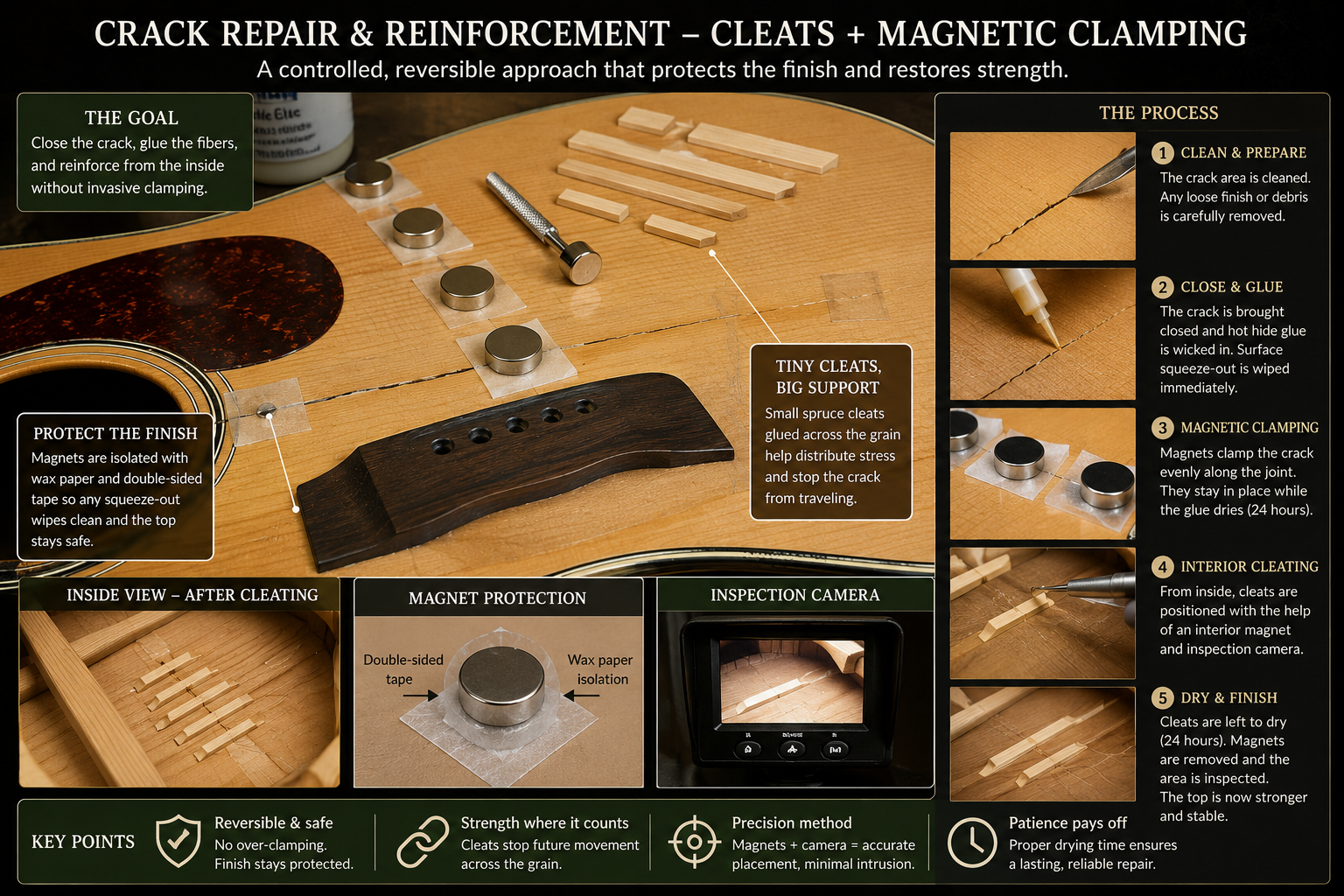
6. Do not casually add stiffness during repair
A giant cleat or patch can stop movement at the crack yet move the stress to the edge of the repair. The usual goal is to restore continuity with the minimum reinforcement compatible with long-term stability. Cleat grain, size, spacing, fit and adhesive all matter.
7. Match string load to the instrument
A modern structurally healthy guitar should be used within its intended range, not automatically detuned out of fear. But a lightly built vintage instrument, unusually tall saddle, lifting bridge, weak bridge plate, loose brace or active top distortion deserves evaluation before a meaningful permanent increase in string tension.
Section 11
Diagnostic Priorities for Owners and Luthiers
The fastest route to a correct diagnosis is to ask what moved, what restrained it, and where the weakest point released. The visible line should then be classified as wood fracture, seam failure, finish checking, bridge-joint separation, brace failure, or some combination.
Click each diagnostic check to expand it. The original owner/luthier responsibilities and the reason each check matters are preserved.
Dryness and over-humidification produce recognizable but different geometry; 45–55% RH is a widely used manufacturer target.
A sunken top suggests dryness; excessive swelling/belly with high action may indicate high MC; some belly is normal.
The repair method differs completely among finish checking, seam failure and wood fracture.
Bridge peel can accelerate and shifts load into a smaller bonded area/top region.
A loose brace can be both a consequence of moisture cycling and a cause of abnormal plate deformation.
Commercial string sets can differ materially in aggregate static tension.
These features alter crack strength, stiffness distribution and bond quality.
Thermal shock can check finishes; severe heat can accelerate moisture loss and joint problems.
Decay and insects can severely reduce wood strength and require treatment beyond an ordinary crack glue-up.
Repairing a plate while it is dimensionally abnormal can lock unnecessary stress into the structure.
A Note From the Bench
“A crack is rarely just a line that needs glue. First I want to know what made the line open, what is still moving, and what the guitar is trying to tell me.”
— Jack, Dr Guitar Care
A Little Bench Humor
Wood Has a Long Memory—and No Respect for the Calendar
A guitar can spend ten years behaving itself and then pick the coldest, driest week of January to announce that it has been keeping notes.
That is why a hygrometer usually tells me more than the guitar’s birthday.
Technical Sources & Further Reading
Where the Wood Science and Manufacturer Guidance Come From
This article was developed from a longer technical research paper combining wood-science references, manufacturer care guidance, adhesive research, musical-instrument aging research, string-tension data and repair literature. The links below are the most useful starting points for readers who want to go deeper.
Quick Review / Search Q&A
Frequently Asked Questions About Acoustic Guitar Cracks
These short answers summarize the major diagnostic points without replacing the full article. They are written in plain language for players, owners, and anyone trying to understand why an acoustic guitar suddenly developed a split.
Closing Thought
The Crack Is the Last Step, Not the First
Humidity supplies dimensional movement. The rim, braces and joints turn part of that movement into stress. String tension keeps bending the top through the bridge. Grain and species determine how the wood moves and how readily a defect can spread. Glue and previous repairs determine how the interfaces tolerate that movement. Time allows creep and repeated cycles to accumulate.
That is why a guitar that cracks after ten quiet years may still have a completely understandable mechanical history. It is also why a well-built guitar kept in a stable environment has no fixed ten-year, twenty-year, or other calendar expiration date.
Protect the environment, watch changing geometry, respect the intended string load, and diagnose the structure before treating the line. The goal is not merely to close a crack. The goal is to keep it closed without creating the next one.
Back to Top